

https://store.steampowered.com/app/3816030/DayZ_Badlands/Salutations, Survivors!
Welcome to our third dev blog for the DayZ Badlands expansion! In case you are wondering why this dev blog came early, we mentioned in the last article that we would be doing one every 3 weeks instead of 4, as a compromise between our original plan and the schedule we had for DayZ Frostline. This particular dev blog serves as an extension of the previous one, where we talked extensively about civilian clothing. This time around, we are getting into military and higher-tier gear, as well as some new melee weapons that you will see in DayZ Badlands. We have also snuck in a small firearm.
This dev blog was primarily written by our colleagues on the art team.
We really enjoy putting these dev blogs together, and if you have not already, please wishlist DayZ Badlands. Your support means a lot to us.
Without further ado, let’s get into it!
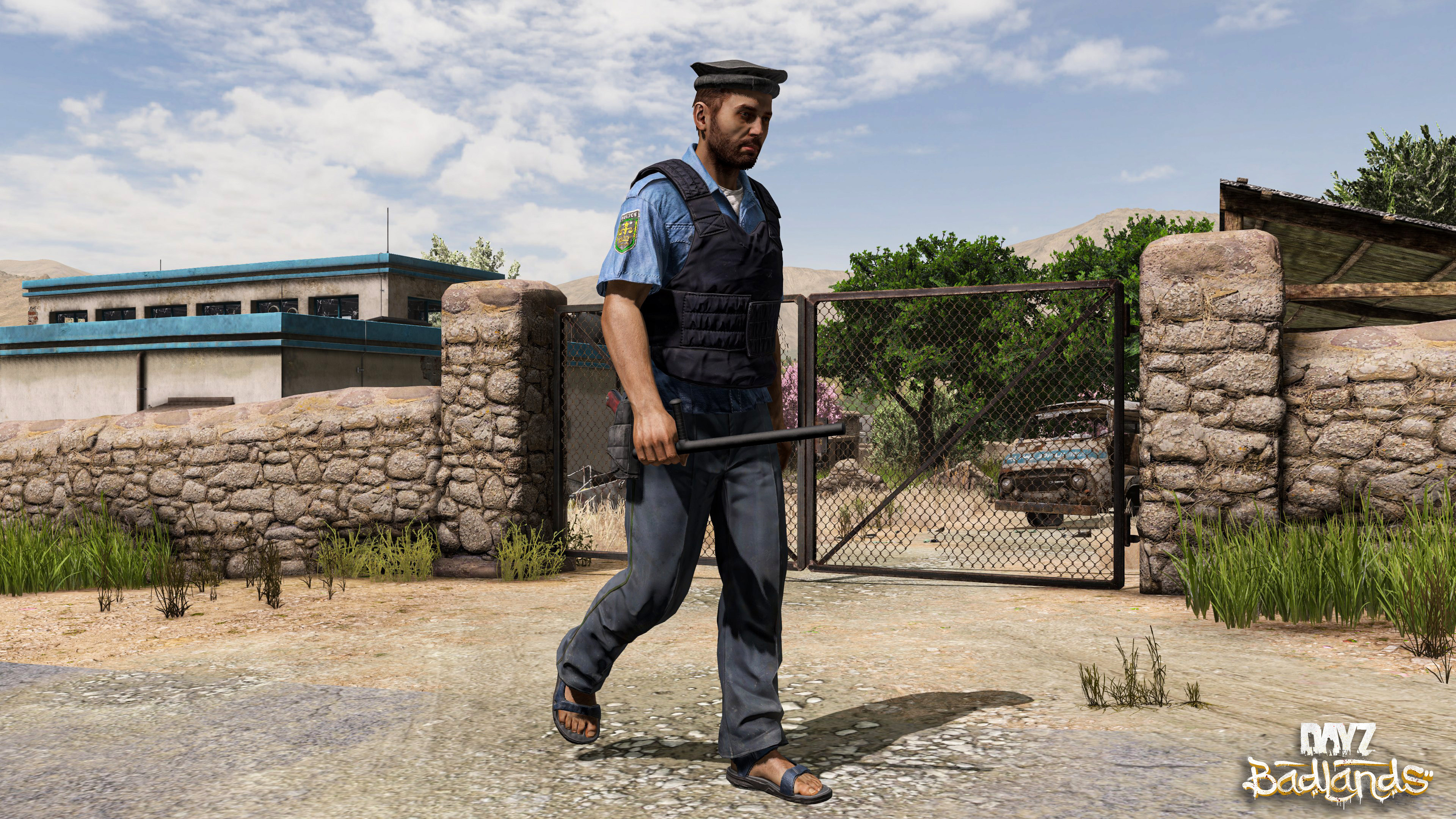
For police clothing, we created a short-sleeved uniform shirt with a lightweight silhouette, using shoulder epaulets, chest pockets, and a classic collared cut to keep it readable as police gear at a glance. We also explored several iterations of the local police patch, using real regional police badges, shield shapes, circular emblems, official signage, and local typography as reference. The final direction keeps the look official, but fictional enough to belong to Nasdara.
 [c]A short-sleeved uniform shirt[/c]
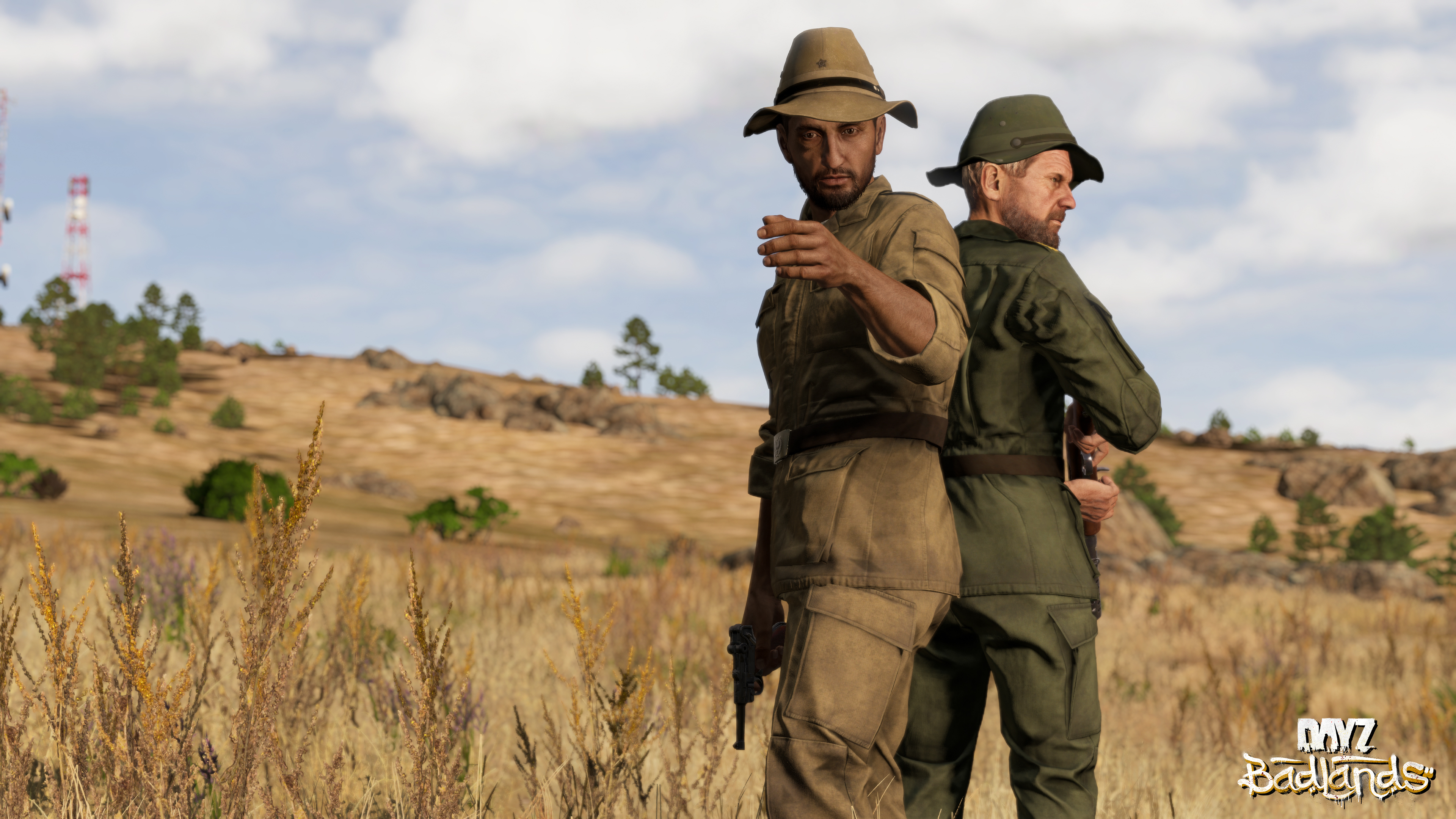
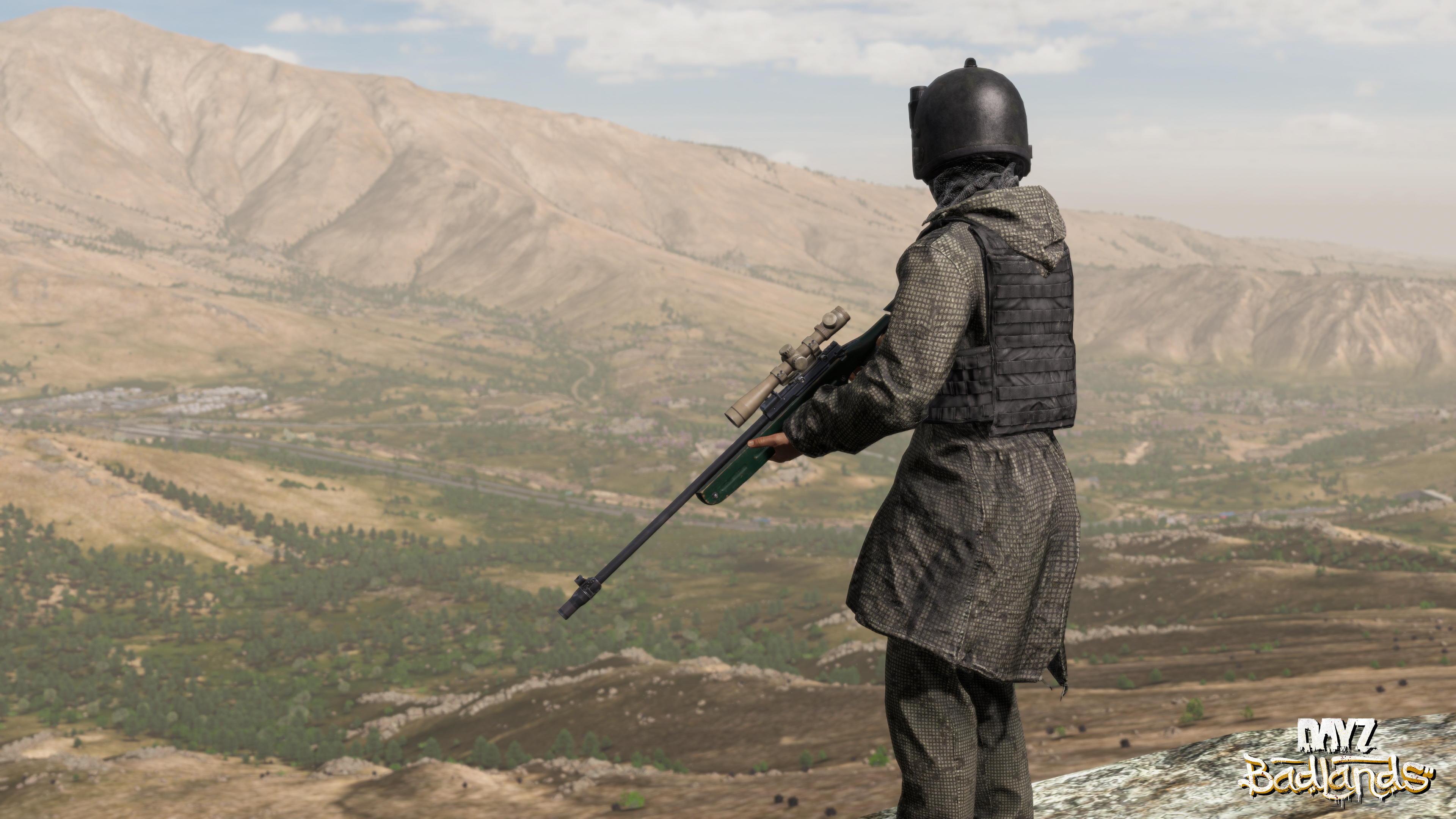
On the military side, the OBR and FNO uniforms cover two different roles. The OBR uniform has a more standard field-uniform feel, with practical details like roll-up sleeves, epaulets, and flap pockets. The FNO jacket is more specialized, built around a longer field-jacket silhouette with a hood, fishtail back extension, drawcords, and a night desert camouflage pattern.
 [c]OBR Uniforms[/c]
Compared to the greener woodland gear seen in Chernarus and Livonia, these uniforms use more beige, olive, faded blue, and night-desert tones. The wear treatment also leans more into dry dust, faded fabric, and sun-exposed materials, helping them feel more at home in Nasdara without losing the grounded DayZ style.
 [c]FNO Night Desert Camo Uniform[/c]
Art Direction of DayZ Badlands
Beyond the production and improvement of assets, the art team has worked on rethinking its pipeline and approach to creating Nasdara and its inhabitants. DayZ Badlands is in many ways an opportunity for us to do things differently and better. Of course, this direction still respects the founding spirit of DayZ, but offers a clearer and more cohesive vision. Our broader goal is simple: to make the infected look and feel more human.
 [c]Regional Military Infected[/c]
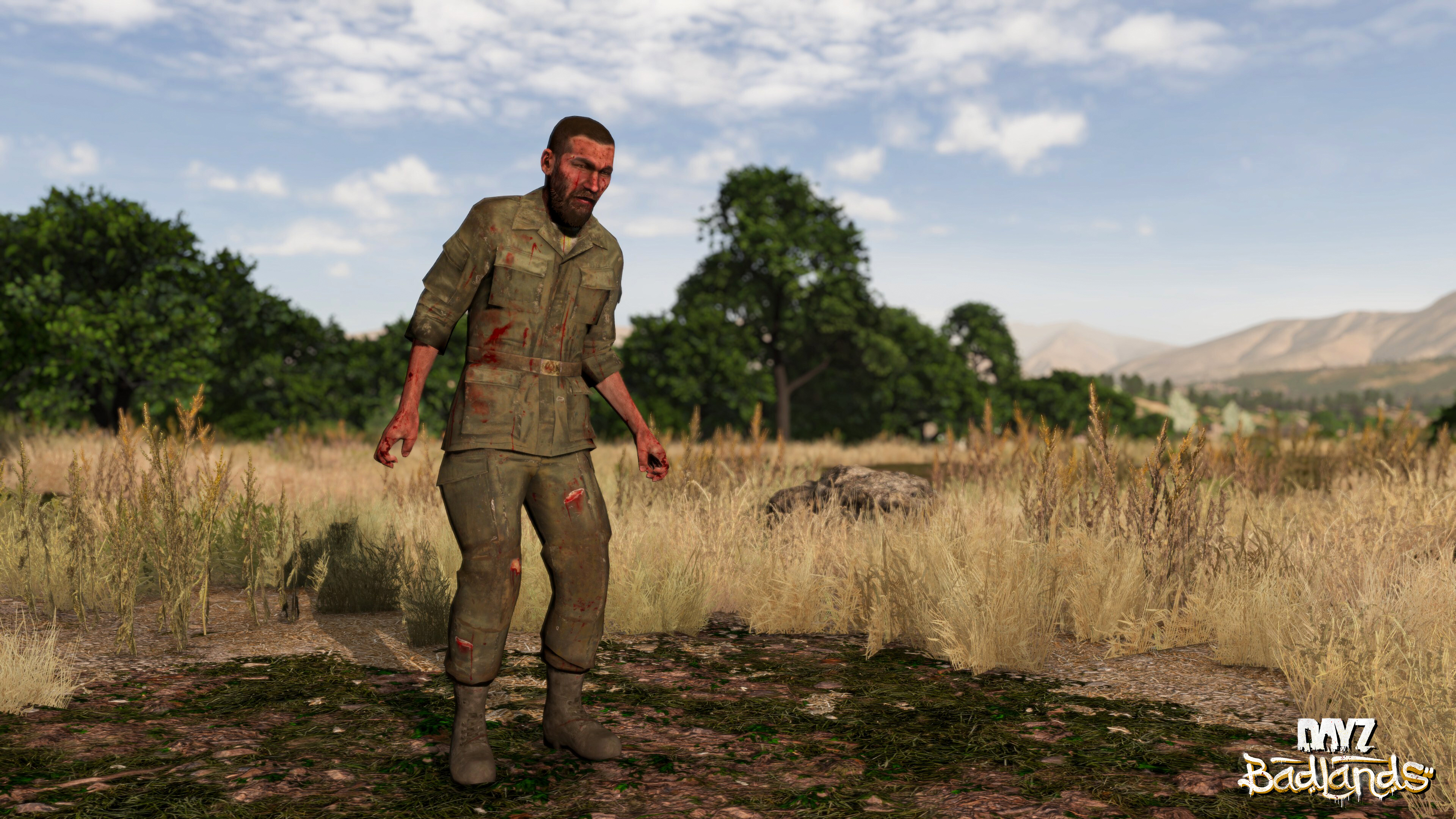
As you may already know, the “infected” are just ordinary humans who contracted an unknown disease in the initial outbreak. That makes them extra violent toward you, the immune few: the survivors. The visuals of the Nasdara infected should reinforce this, as well as the fact that infected exist because of the disease and are not merely a generic horror movie spectacle of “undead zombies.”
We focused primarily on three pillars as part of the new art direction for Nasdara:
We approached this process with a guiding principle: subtlety.
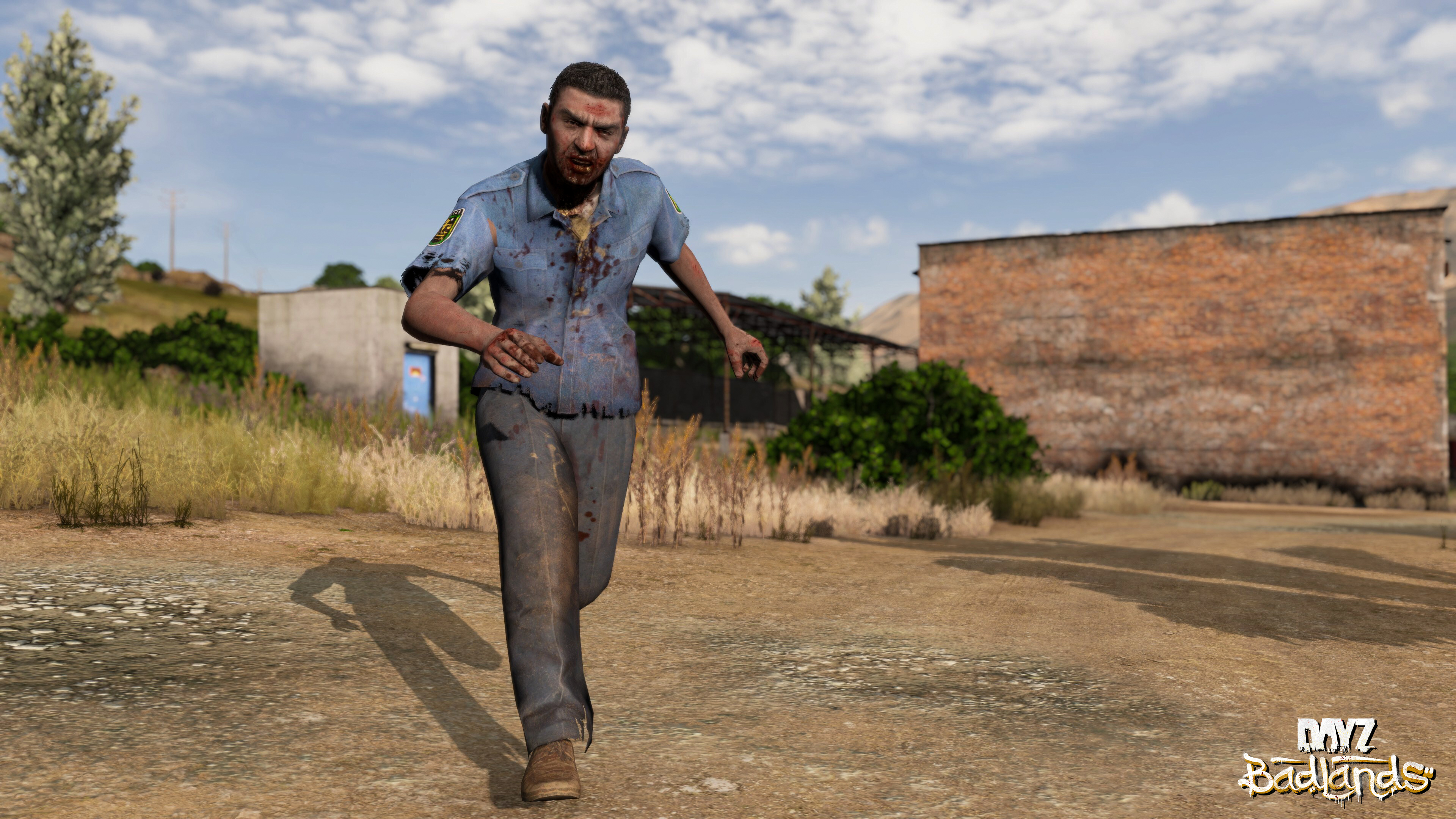 [c]Regional Police Infected[/c]
The effects you see on infected are now more distinct and identifiable, but every symptom, stain, and injury has a logical cause that links them together. A torn uniform tells you where they worked. Bruises, vomit, cuts, sunburns, and sweat show how much the body has endured and how far gone it is. Every stain has a source. Nothing is decorative. Everything is a clue. More details on infected below.
The Infected of Nasdara
We wanted the infected to feel like they truly belonged in Nasdara, not like they had simply been carried over from previous regions. Regional garments were a big part of that, including local civilian clothing, workwear, police pieces, and military-related items. But we also paid close attention to how Nasdara’s environment would affect their bodies and clothing.
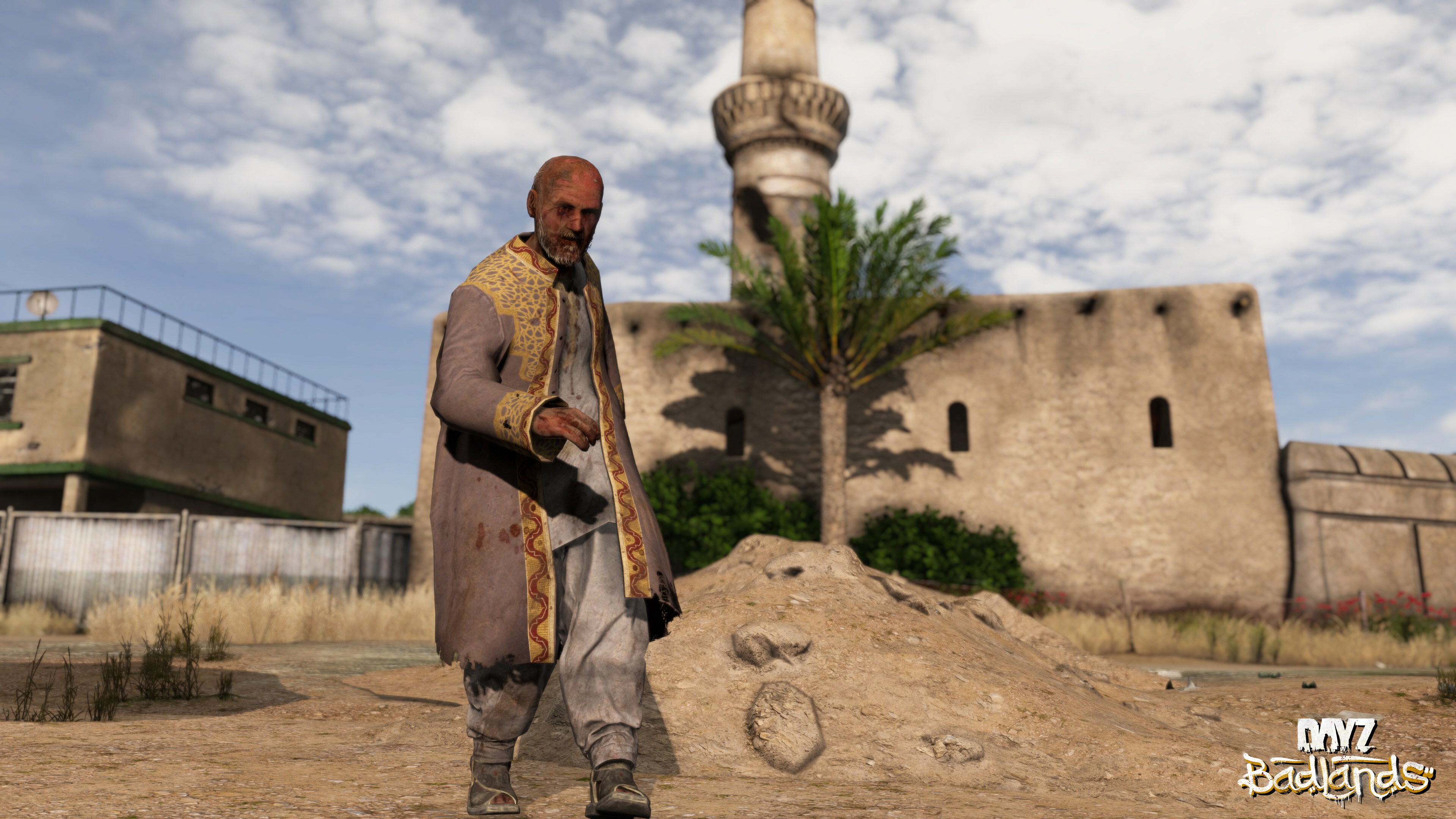 [c]Regional Civilian Infected[/c]
For this map, the infected went through a deeper visual direction pass to better connect them to a Middle Eastern-inspired region while still keeping them grounded in DayZ’s overall infected style. The art department also created shared resources and visual guidelines to help keep the infected cohesive across the whole set, especially since multiple artists were working on different models. This helped keep details like skin treatment, dust, sweat, sun exposure marks, clothing wear, and color grading consistent.
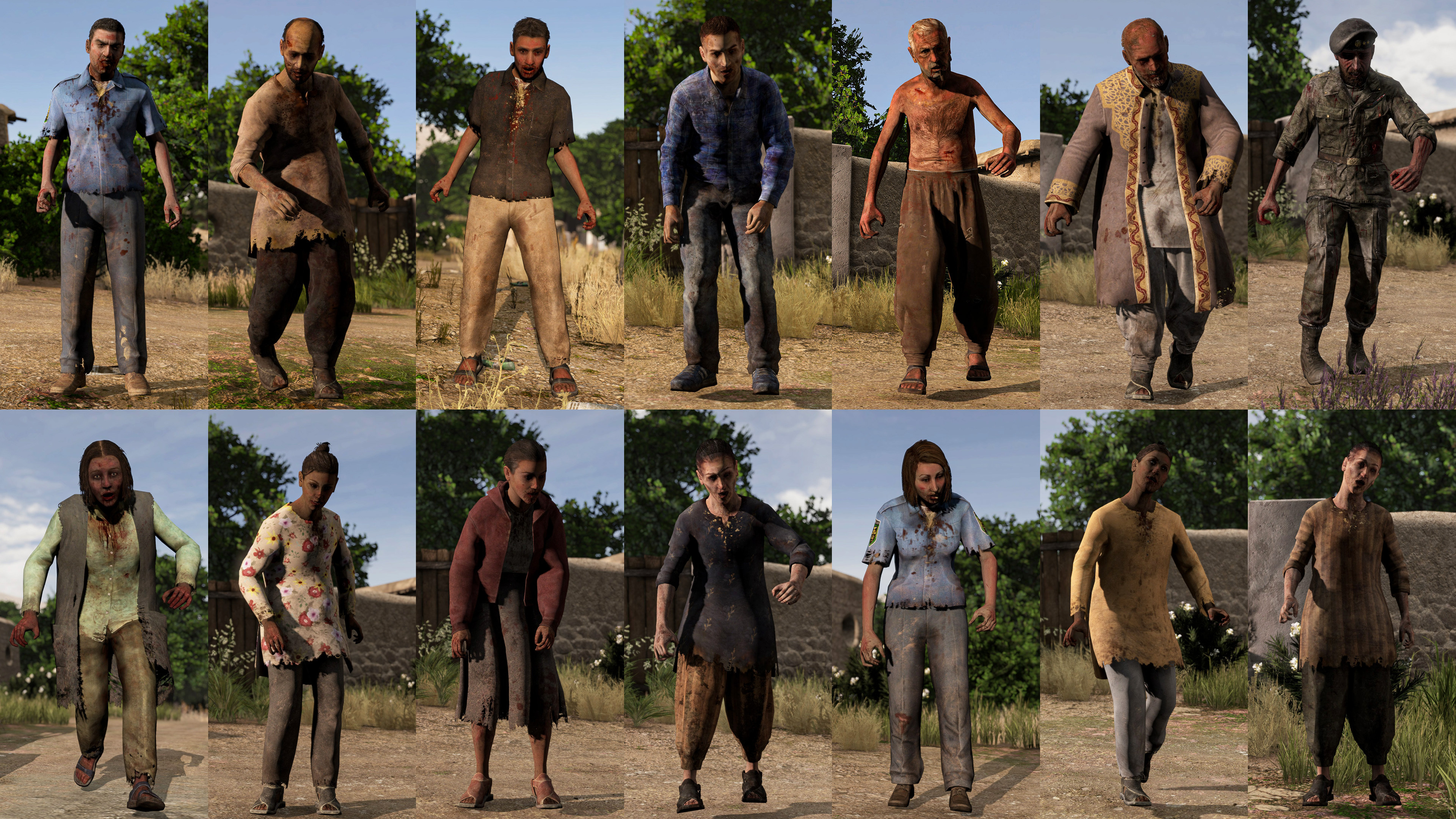 [c]Variety of Infected (Without color variants)[/c]
Instead of relying on the darker, wetter, mud-like dirt that fits Chernarus or Livonia, the Nasdara infected use lighter dust, dry grime, faded fabric, sweat staining, sun exposure marks, and heat-related skin details. The idea was to make them feel shaped by the same harsh climate as the rest of the environment. They are still recognizably DayZ infected, but their clothing, skin, weathering, and overall palette should immediately tell the player that they are somewhere different.
https://store.steampowered.com/app/3816030/DayZ_Badlands/Melee Weapons in DayZ Badlands
Nasdara as a fictional, Middle-Eastern region gave us the opportunity to explore a very rich collection of countries and cultures to research and include, and melee weapons are a great example of this. DayZ Badlands comes with a collection of iconic regional melee weapons, such as the Shamshir-styled scimitar, the Jambiya curved dagger, and the Akinaka. Naturally, there will be other varieties of non-historic melee weapons to find in urban areas, like the Police Baton for knocking out assailants, or the Döner Knife, ideal for slicing meats.
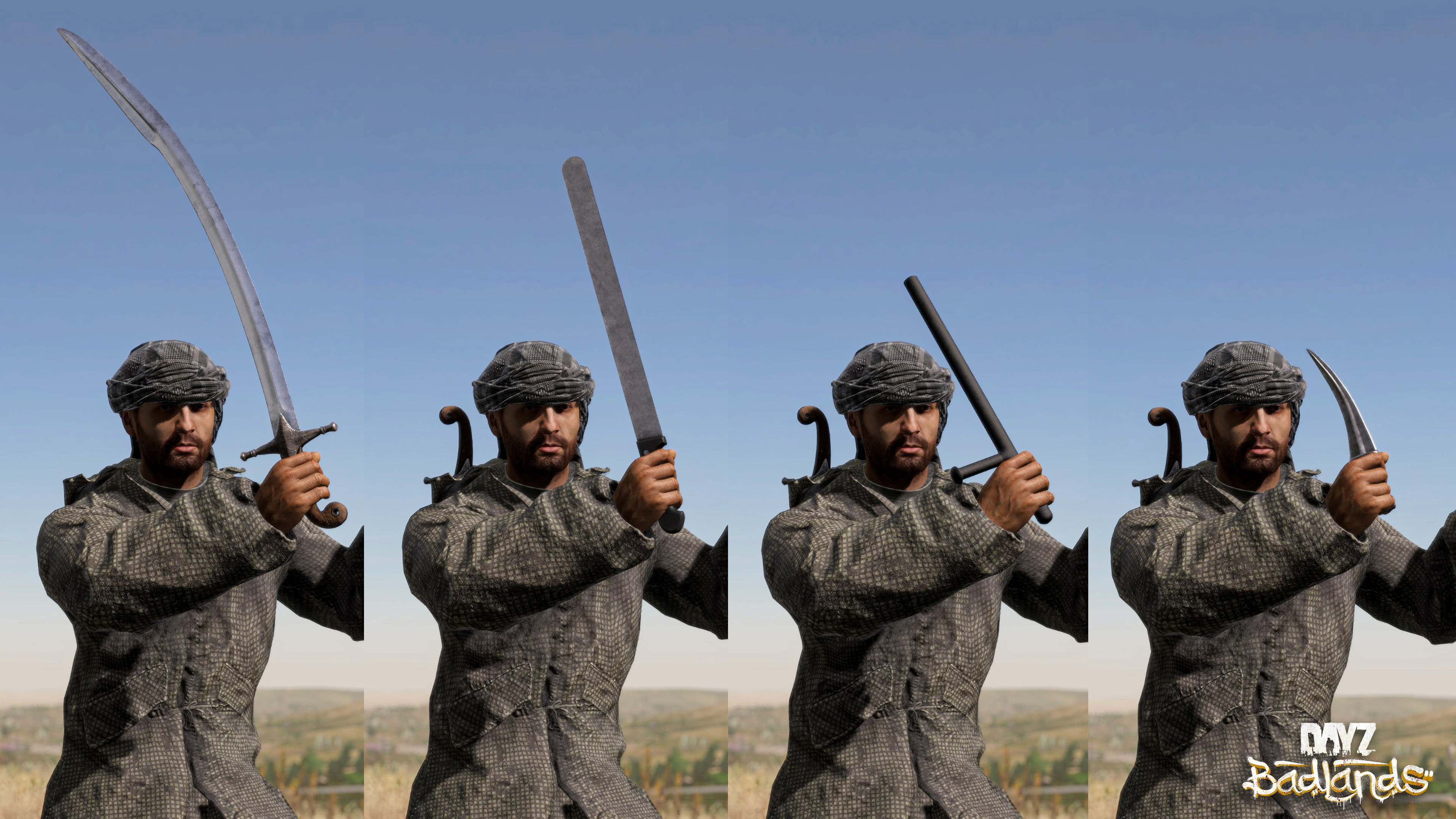 [c]From left to right: Scimitar Sword, Döner Knife, Police Baton, Jambiya Dagger[/c]
Determining which real references best suited the collection in Nasdara usually started with researching the Persian Gulf region's history in weapons, and extending that outwards to the Arabic Peninsula, or occasionally east, towards South Asia. Many of these weapon styles are hand-crafted to be unique and occasionally luxurious. Museums, auction houses of historical artifacts, and documentaries on these regions and their art heritage were good points of reference to find an exemplary item. For instance, in real life, every Jambiya is unique in their materials and decoration. Each of them speaks to their origin and its owner’s prestige.
We were keen to include these unique weapons in Nasdara to enhance the experience of the region being old and rich in its heritage. The craftmanship tradition of blades is unique and deep in the real-world cultures that inspired the creation of the Takistan region. Our hope is that players will find something special in these items that invites them to drop their old blades for something that stands out.
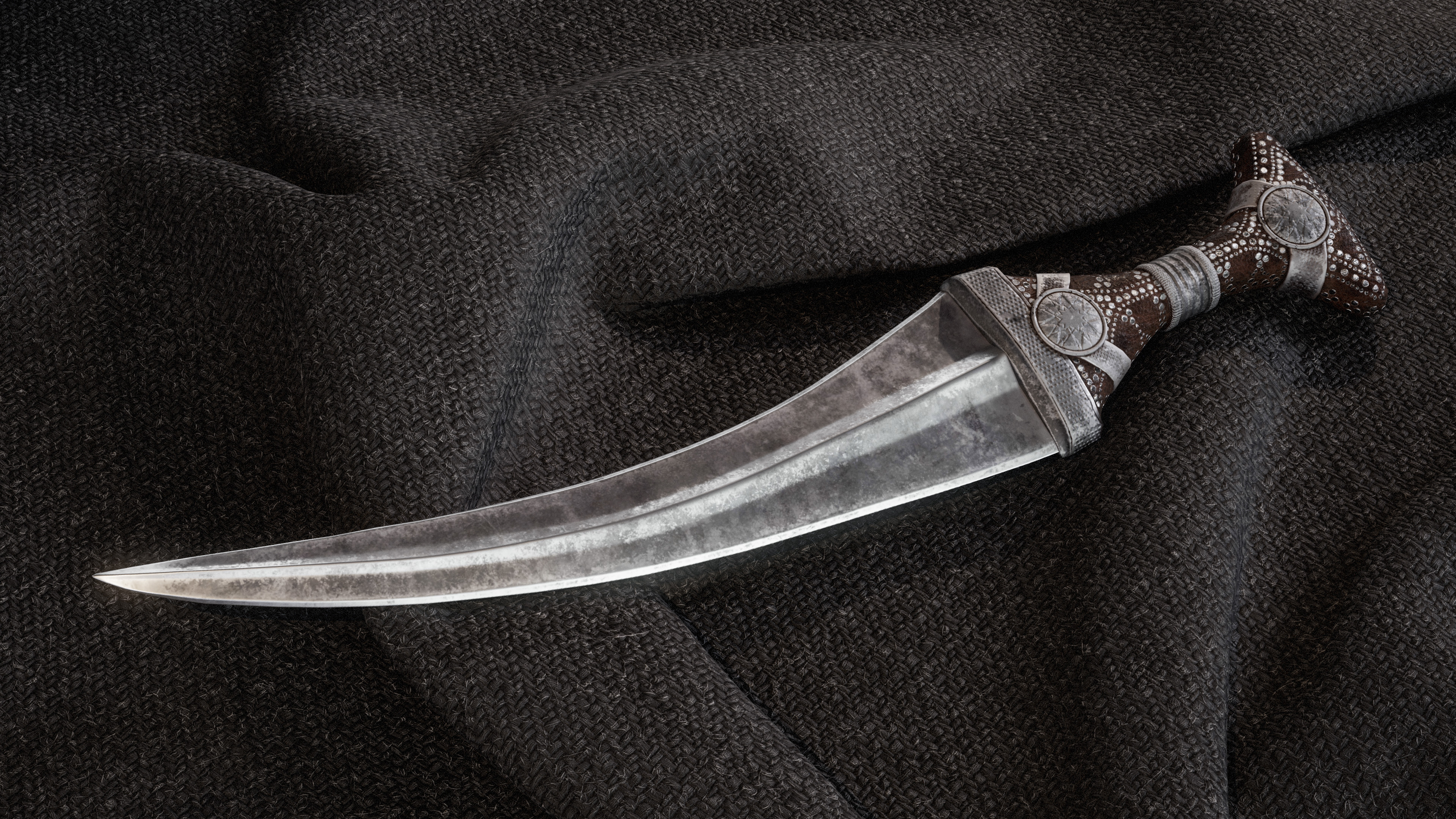 [c]The Jambiya Dagger[/c]
Another example coming in DayZ Badlands is the Akinaka. This original Scythian design for a double-edged blade has been around for over two and a half millennia. It's been used by various civilizations over centuries, but has been recognized as a Persian weapon since ancient times. It was used as a short sword by the Greeks, as well as a side-arm, and even as a ritual and burial dagger in ancient Persia. This is an exceedingly rare artifact and it should communicate that whoever holds one in their hands has mastered survival in hostile Nasdara, or perhaps bested someone who did.
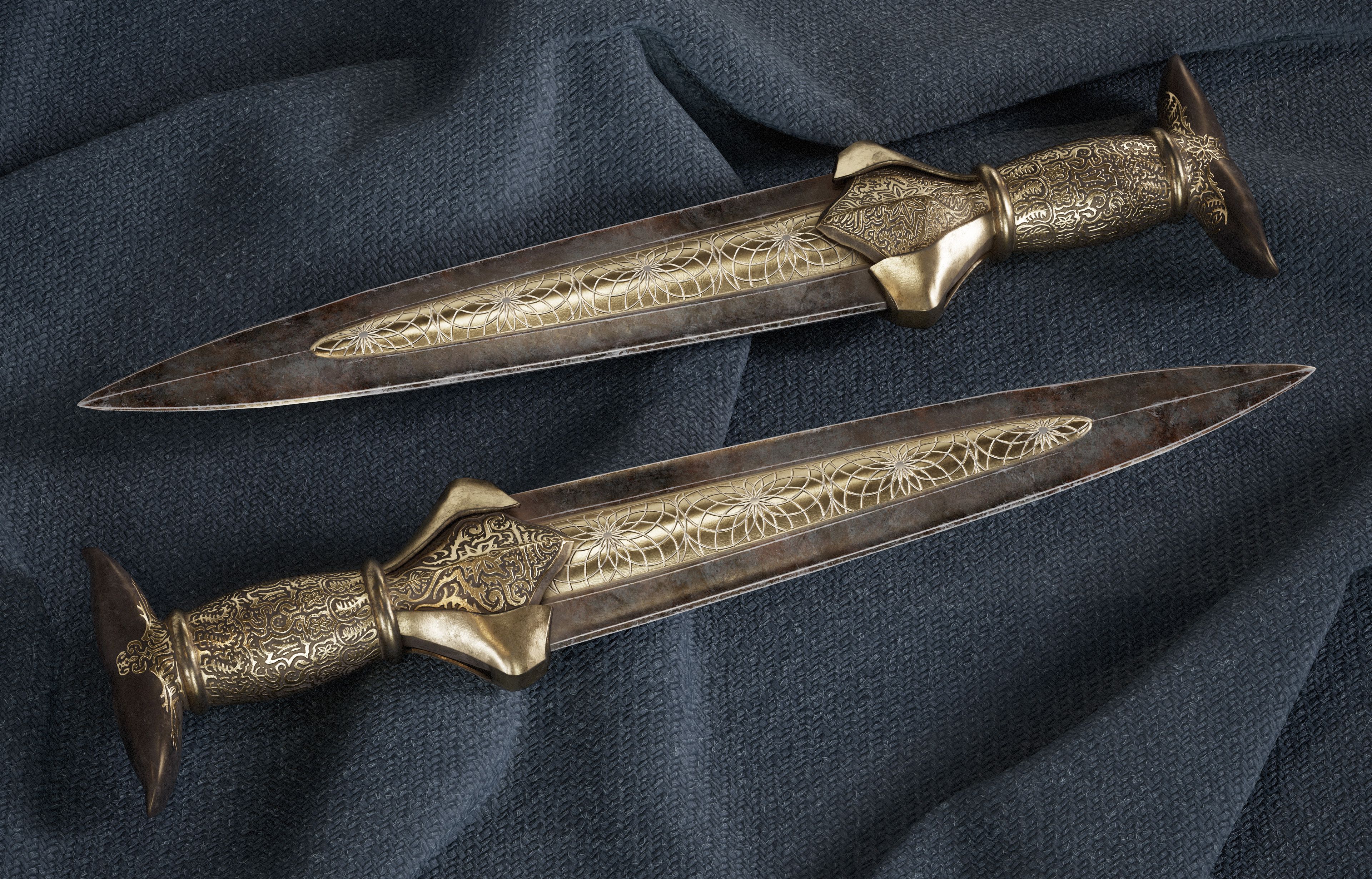 [c]The Akinaka Dagger[/c]
DayZ already has a wide choice of hand-to-hand weapons. So it’s important that players find good use in these new melee blades, especially if they're rare, historical loot spread thin across a large region. The scimitar, which you might commonly understand as a Middle-Eastern type of saber or sword, is wielded with one hand, which makes it a fearsome, damaging, and long-reaching melee option with a quick swing. The Jambiya dagger, to account for its traditional metal treatment, will have a higher condition value than regular knives, allowing you to continue using it longer before the need for a sharpening tool.
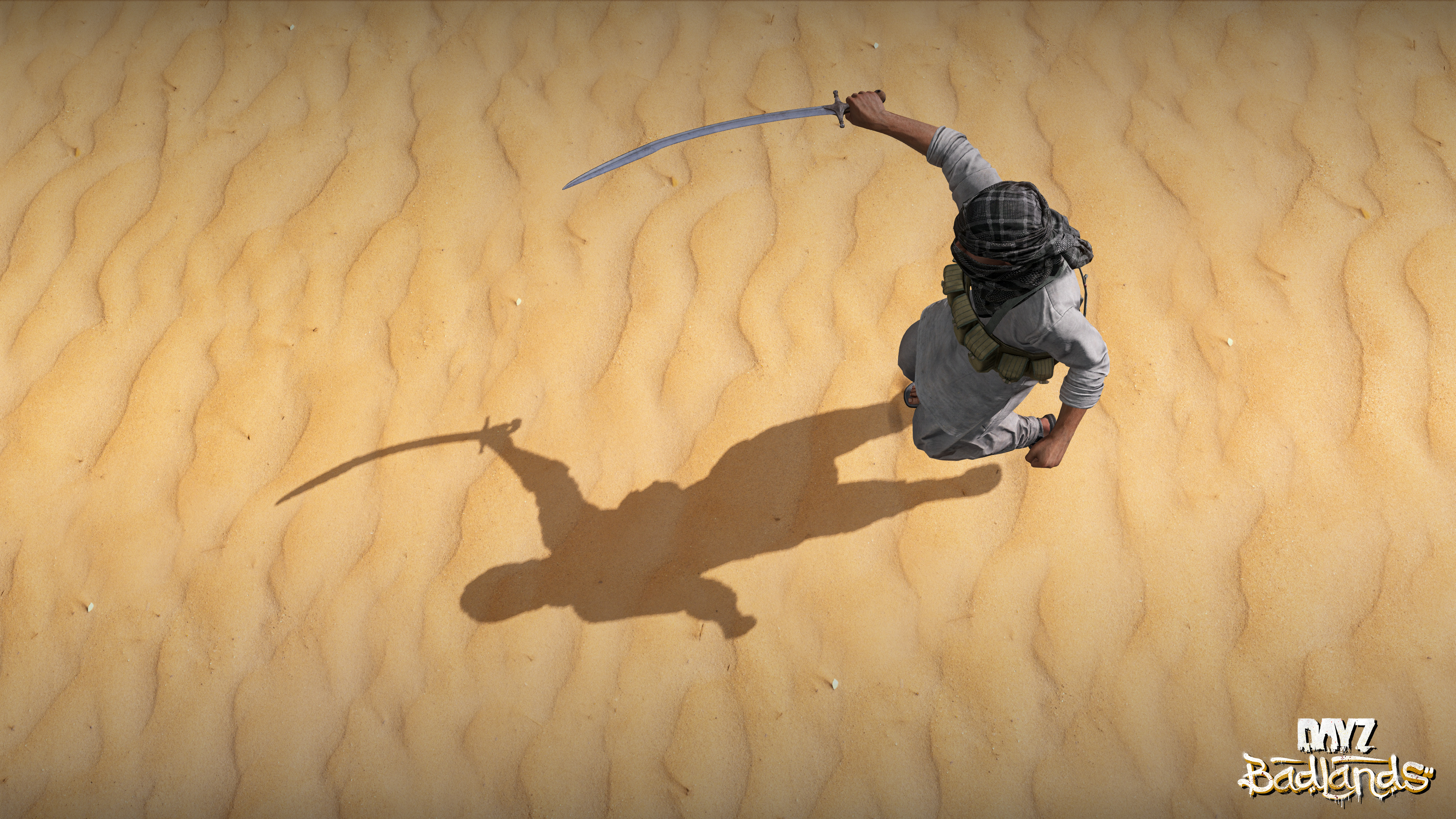 [c]The Scimitar in Action[/c]
Let's get down to the brass tacks of how we make these weapons.
Once we gather a variety of options for reference, we start with a simple silhouette model before going into higher polygon counts. This first block-out model helps check what the dimensions of the weapon should be, if they look good in the player's hands and on the ground when looted, and if their effective range feels appropriate and authentic to the real item's size. Then a high-detail model is created, from which decoration details and the profile of the shapes are baked down into the texture.
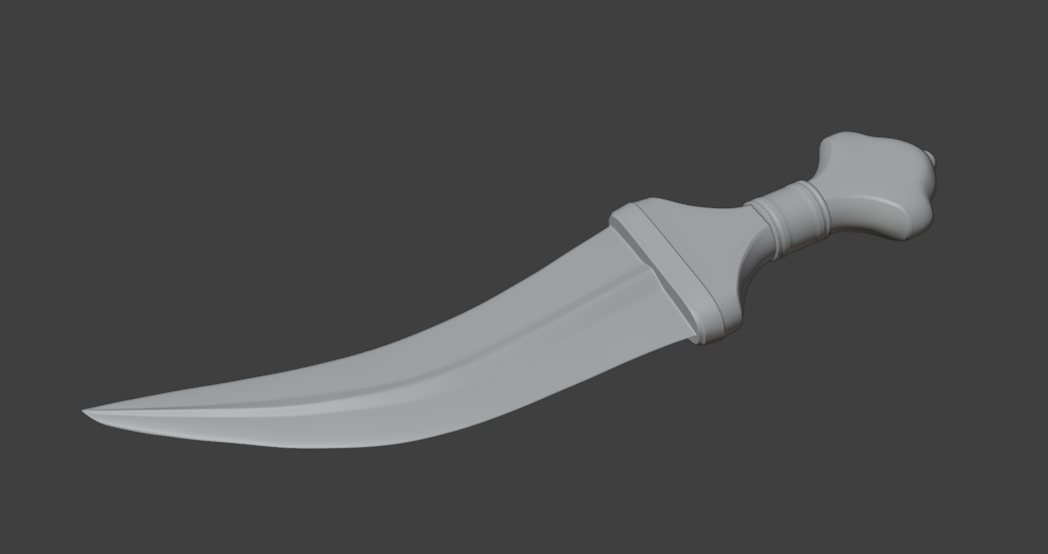 [c]First revision of the Jambiya[/c]
For example, this was an early, first revision of the Jambiya, modeled after a different real example, with a much broader blade and steeper tip. While it matched the silhouette of the specimen, it just didn't look eye-catching enough in the hands of the player once in-game. So a new specimen with a slimmer blade and sharper profile was chosen. A second set of references was then used to texture the item, to get a good feel of the metallic and non-metallic parts, and to see how they look under the strong Nasdara sunlight, or under an overcast sky. Once the look was done, optimized models were then made and finally configured in-game. We're excited for players to see the complete melee collection in DayZ Badlands.
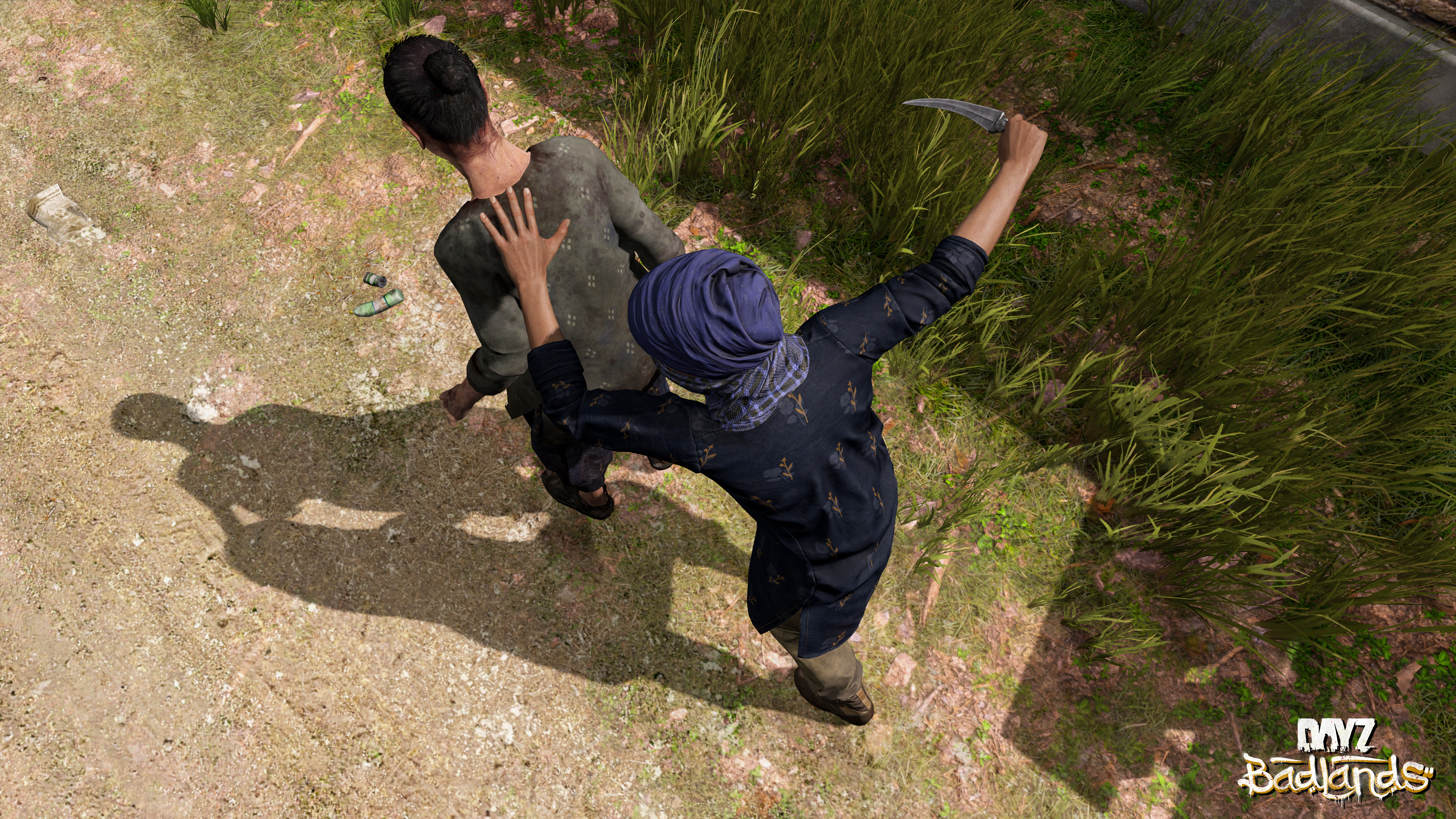 [c]Stealth-takedown with Jambiya Dagger[/c]
https://store.steampowered.com/app/3816030/DayZ_Badlands/The Luger Pistol

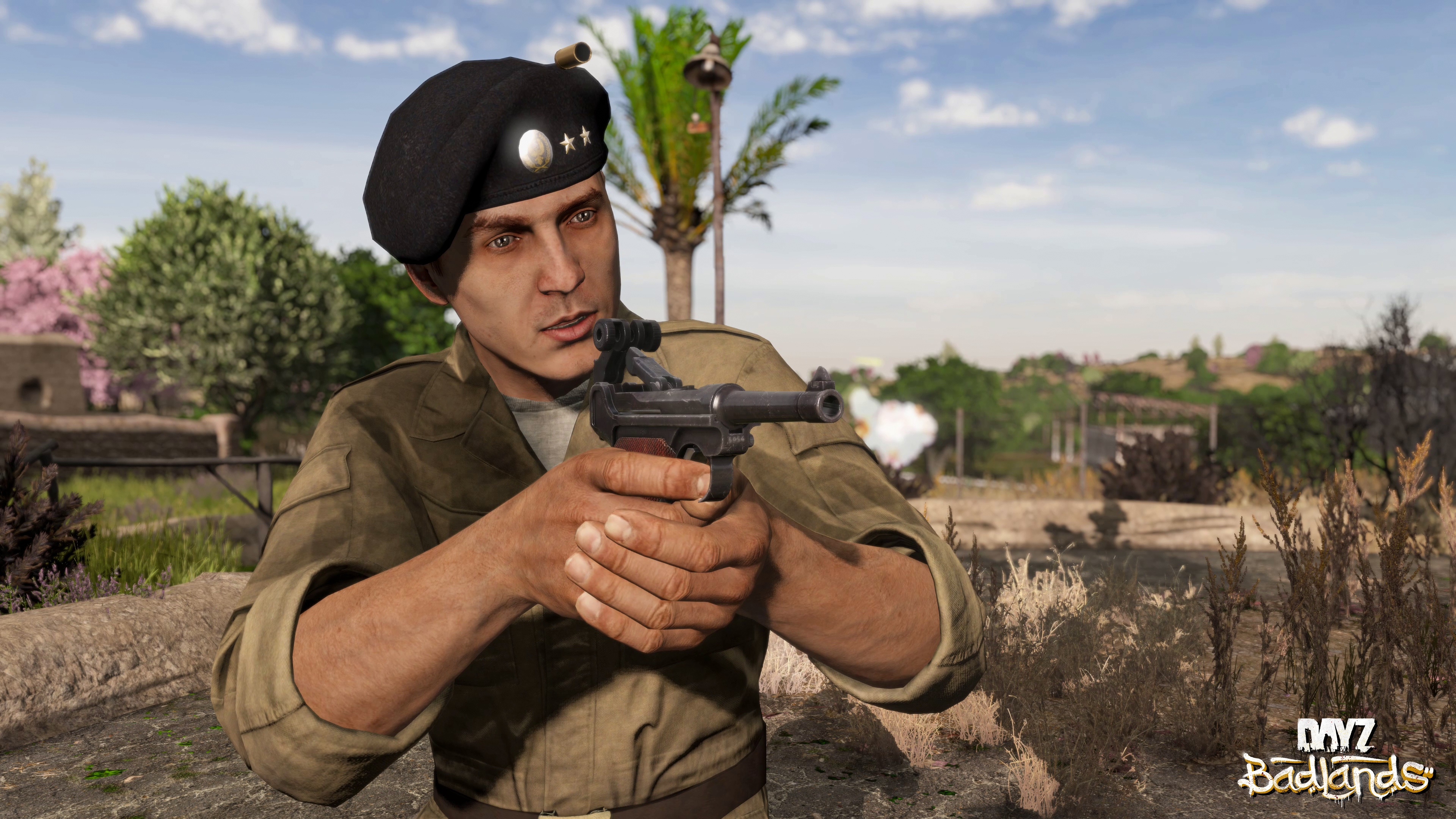
We were looking into weapons that could make their way from the fronts of The Great War to Takistan, so a weapon that was a popular sidearm made sense. The P08 feeds from a detachable magazine like a modern firearm. Unlike a modern pistol, however, it uses a toggle lock system to hold the breech and the barrel together as they jointly travel for a short distance before the toggle is cammed and the weapon is allowed to eject a spent casing and load a fresh round. It is also devoid of oddities such as internal magazines that were dead ends in handgun evolution. That makes it special in firearm history. The design held up well and the weapon was an outstanding success. It was used by many European armies and was even considered by the US Army at one point, albeit in a different calibre.
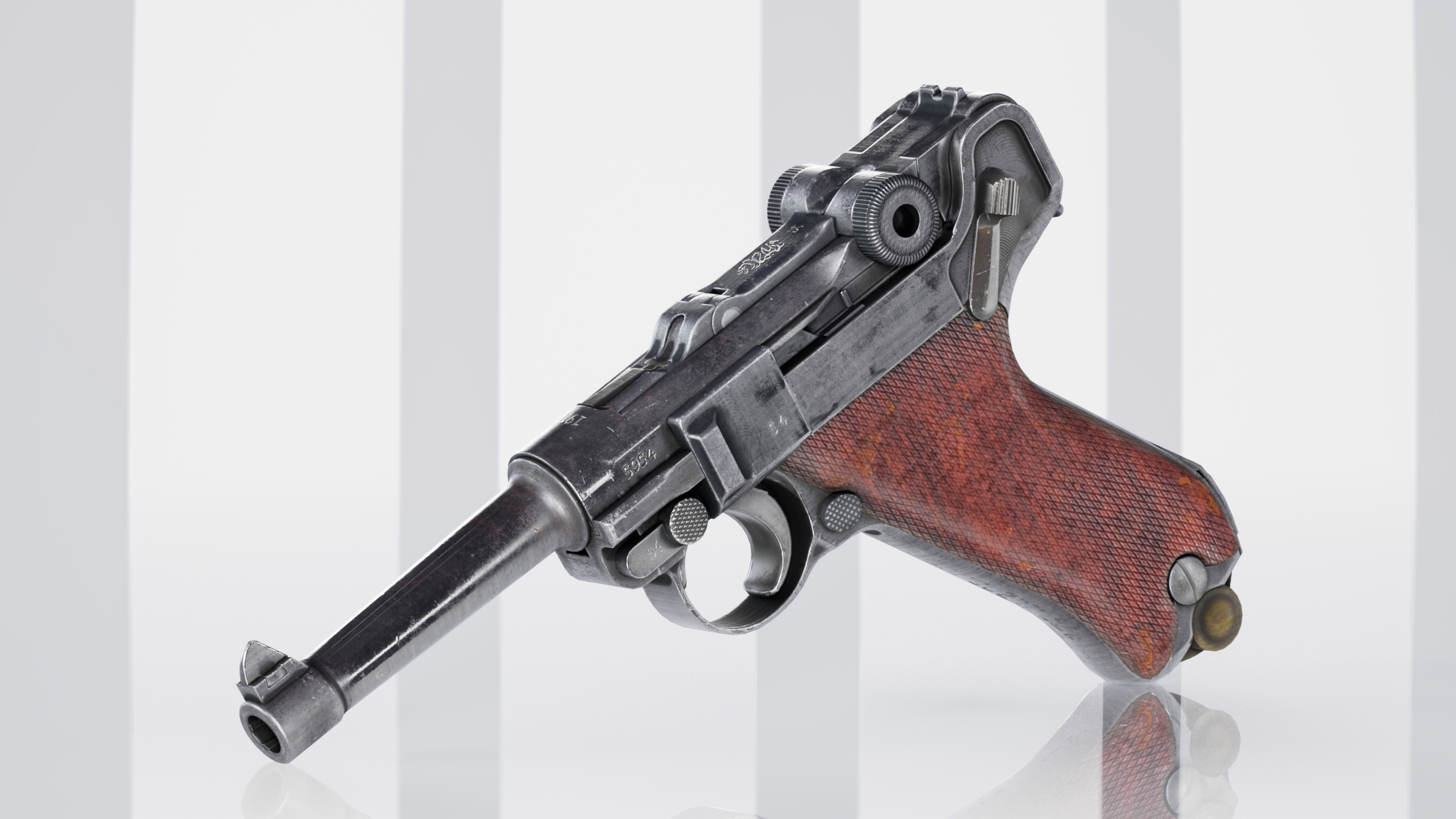 In terms of research, in cases when a weapon was manufactured over many decades and in different places, there is a lot of variation within the type and you have to avoid mismatching features that could not occur together or mismatching features with weapon markings. This is the danger of using photographs from different sources. In practice, it is best to find a specimen and make it your "main reference": a weapon with multiple high-resolution photographs available from all angles that tie the features together. The best sources are museum pages and auction house bids because their descriptions can be trusted, as can the originality of the date of production on the weapon. In cases where there is no set of photographs covering all angles, you have to supplement pictures from other sets and cross reference the features to make sure the two are from a close enough batch. Sometimes there are swapped parts on a weapon from a different batch as originals were damaged or lost, so never trust a single photo unless you can back it up with searches.
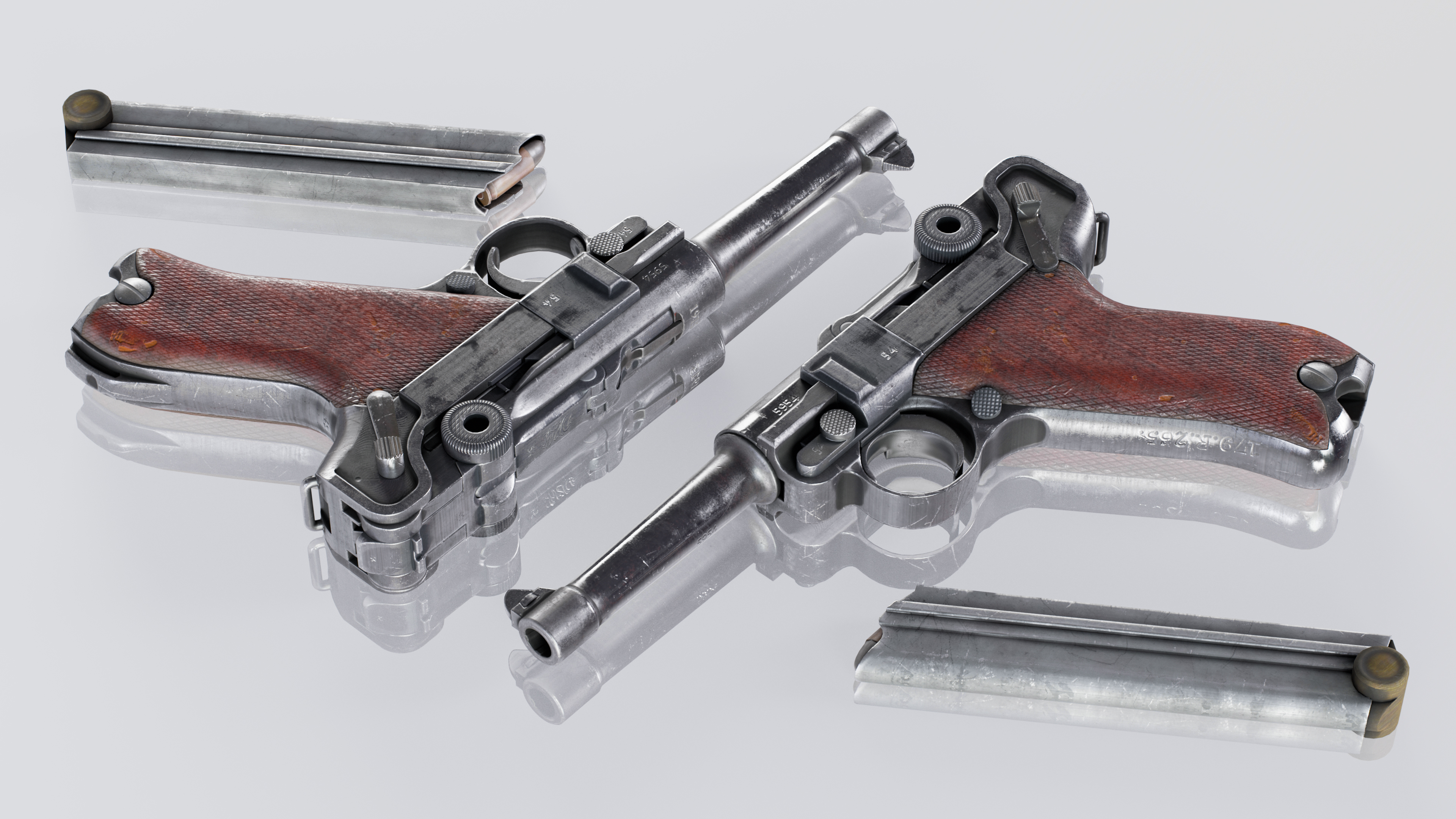 Blueprints also cannot be trusted. Most "blueprints" on the internet are illustrations, not actual plans. Finding professional photographs made with narrow lens angles with low distortion is best. Mobile cameras usually use a wide lens so they carry a lot of distortion. You can sometimes correct distortion if you know the exact lens type, but that is more reliable for DSLR photos, as libraries of corrections exist.
While getting the side of the weapon is usually easy, getting a reference for width is the complicated part. Sometimes no good angle is available and a lot of deduction is needed to tie the width at different points to other dimensions.
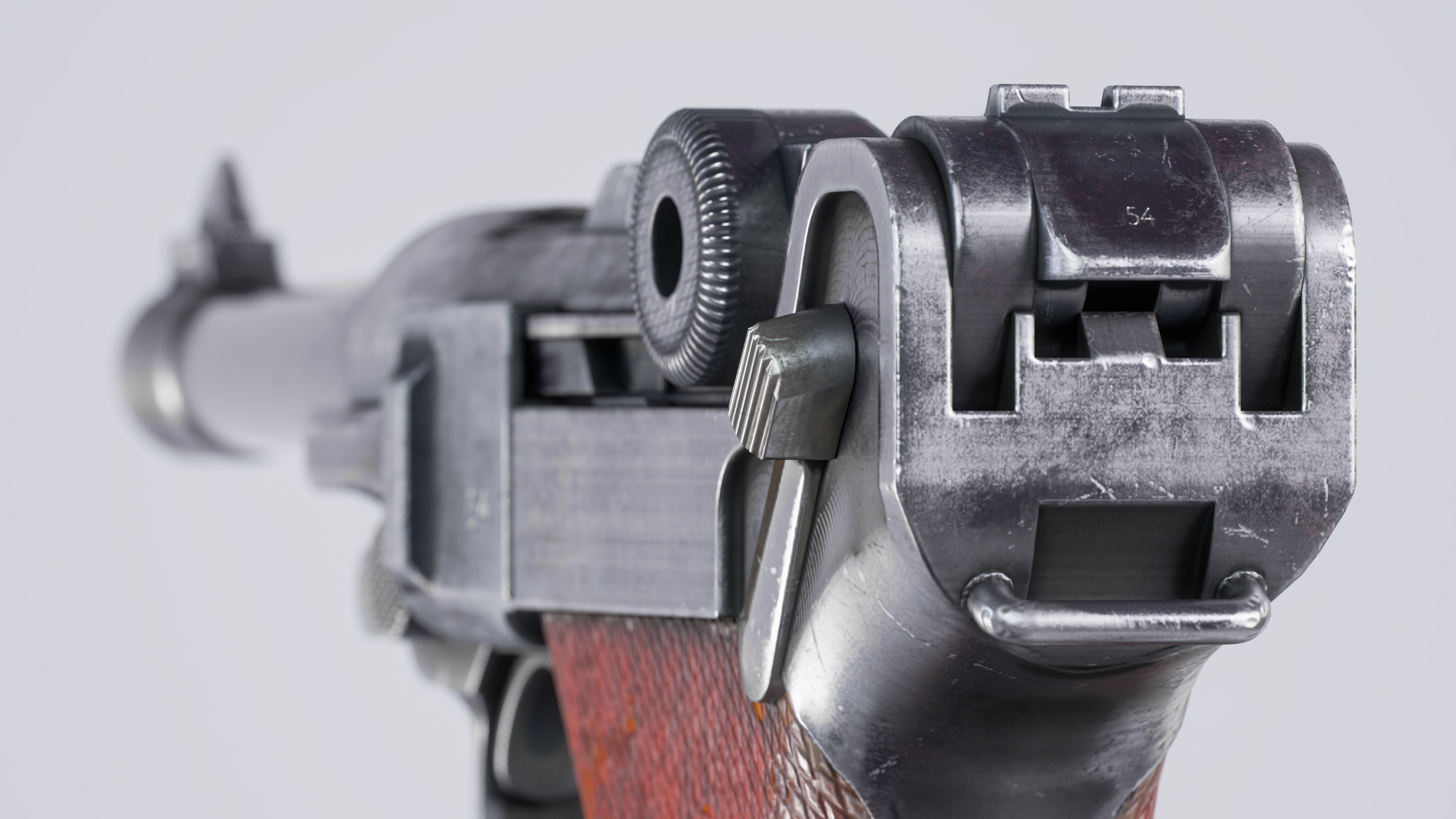 On the topic of texturing, other than getting the finish on parts correct and the markings to look authentic, there is a lot of work to make the item look like something found in the world. First of all, the finish needs to be slightly uneven on all parts, as well as slightly different between parts. Applying finish to metals is a finicky process and small changes to the composition of chemicals, timing or temperature can produce distinct shades. It is rare for different batches coming out of the bath at a factory to match perfectly. There are also other manufacturing imperfections such as machining marks that are visible through the finish (those add to the character). Weapons also get wear from use and from negligence. Scratches and the fading of the finish should be referenced with IRL photographs because they are not random in nature. Dust, rust, and powder residue - wiped away and applied over and over again, usually most visible in places the finger tips cannot reach – should also be referenced. All of these qualities make the weapon look authentic.
 Hope you had a lovely read!
So far we’ve focused quite a bit on showcasing gear assets. That's because the topic of clothing was a bit too large for us to cover in one dev blog. Next time around we’ll attempt to get into the topic of PvP opportunities in Nasdara, as well as a little bit into gameplay perspective and more environment assets. Hope you’re looking forward to it.
Best wishes and big love!
The DayZ Team
Contributors
https://store.steampowered.com/app/3816030/DayZ_Badlands/
Continue reading...
Welcome to our third dev blog for the DayZ Badlands expansion! In case you are wondering why this dev blog came early, we mentioned in the last article that we would be doing one every 3 weeks instead of 4, as a compromise between our original plan and the schedule we had for DayZ Frostline. This particular dev blog serves as an extension of the previous one, where we talked extensively about civilian clothing. This time around, we are getting into military and higher-tier gear, as well as some new melee weapons that you will see in DayZ Badlands. We have also snuck in a small firearm.
This dev blog was primarily written by our colleagues on the art team.
We really enjoy putting these dev blogs together, and if you have not already, please wishlist DayZ Badlands. Your support means a lot to us.
Without further ado, let’s get into it!
Regional Uniforms for NasdaraDisclaimer The information shared in our development blog reflects a work in progress. The details discussed are subject to change before release. We intend to share these progress updates to provide some insights into the development process and foster community trust. Thank you for joining us on the road to Nasdara!
For police clothing, we created a short-sleeved uniform shirt with a lightweight silhouette, using shoulder epaulets, chest pockets, and a classic collared cut to keep it readable as police gear at a glance. We also explored several iterations of the local police patch, using real regional police badges, shield shapes, circular emblems, official signage, and local typography as reference. The final direction keeps the look official, but fictional enough to belong to Nasdara.
On the military side, the OBR and FNO uniforms cover two different roles. The OBR uniform has a more standard field-uniform feel, with practical details like roll-up sleeves, epaulets, and flap pockets. The FNO jacket is more specialized, built around a longer field-jacket silhouette with a hood, fishtail back extension, drawcords, and a night desert camouflage pattern.
Compared to the greener woodland gear seen in Chernarus and Livonia, these uniforms use more beige, olive, faded blue, and night-desert tones. The wear treatment also leans more into dry dust, faded fabric, and sun-exposed materials, helping them feel more at home in Nasdara without losing the grounded DayZ style.
Art Direction of DayZ Badlands
Beyond the production and improvement of assets, the art team has worked on rethinking its pipeline and approach to creating Nasdara and its inhabitants. DayZ Badlands is in many ways an opportunity for us to do things differently and better. Of course, this direction still respects the founding spirit of DayZ, but offers a clearer and more cohesive vision. Our broader goal is simple: to make the infected look and feel more human.
As you may already know, the “infected” are just ordinary humans who contracted an unknown disease in the initial outbreak. That makes them extra violent toward you, the immune few: the survivors. The visuals of the Nasdara infected should reinforce this, as well as the fact that infected exist because of the disease and are not merely a generic horror movie spectacle of “undead zombies.”
We focused primarily on three pillars as part of the new art direction for Nasdara:
Regional Influence: Every scrap of clothing and worn detail should hint at who they were before the outbreak: their home, their work, their culture.
Progression of Decay: Every visual element on the infected should tell a story of sickness, neglect, and deterioration.
Visual Storytelling: Every silhouette, texture, and shape should express their story at a glance.
We approached this process with a guiding principle: subtlety.
The effects you see on infected are now more distinct and identifiable, but every symptom, stain, and injury has a logical cause that links them together. A torn uniform tells you where they worked. Bruises, vomit, cuts, sunburns, and sweat show how much the body has endured and how far gone it is. Every stain has a source. Nothing is decorative. Everything is a clue. More details on infected below.
The Infected of Nasdara
We wanted the infected to feel like they truly belonged in Nasdara, not like they had simply been carried over from previous regions. Regional garments were a big part of that, including local civilian clothing, workwear, police pieces, and military-related items. But we also paid close attention to how Nasdara’s environment would affect their bodies and clothing.
For this map, the infected went through a deeper visual direction pass to better connect them to a Middle Eastern-inspired region while still keeping them grounded in DayZ’s overall infected style. The art department also created shared resources and visual guidelines to help keep the infected cohesive across the whole set, especially since multiple artists were working on different models. This helped keep details like skin treatment, dust, sweat, sun exposure marks, clothing wear, and color grading consistent.
Instead of relying on the darker, wetter, mud-like dirt that fits Chernarus or Livonia, the Nasdara infected use lighter dust, dry grime, faded fabric, sweat staining, sun exposure marks, and heat-related skin details. The idea was to make them feel shaped by the same harsh climate as the rest of the environment. They are still recognizably DayZ infected, but their clothing, skin, weathering, and overall palette should immediately tell the player that they are somewhere different.
https://store.steampowered.com/app/3816030/DayZ_Badlands/Melee Weapons in DayZ Badlands
Nasdara as a fictional, Middle-Eastern region gave us the opportunity to explore a very rich collection of countries and cultures to research and include, and melee weapons are a great example of this. DayZ Badlands comes with a collection of iconic regional melee weapons, such as the Shamshir-styled scimitar, the Jambiya curved dagger, and the Akinaka. Naturally, there will be other varieties of non-historic melee weapons to find in urban areas, like the Police Baton for knocking out assailants, or the Döner Knife, ideal for slicing meats.
Determining which real references best suited the collection in Nasdara usually started with researching the Persian Gulf region's history in weapons, and extending that outwards to the Arabic Peninsula, or occasionally east, towards South Asia. Many of these weapon styles are hand-crafted to be unique and occasionally luxurious. Museums, auction houses of historical artifacts, and documentaries on these regions and their art heritage were good points of reference to find an exemplary item. For instance, in real life, every Jambiya is unique in their materials and decoration. Each of them speaks to their origin and its owner’s prestige.
We were keen to include these unique weapons in Nasdara to enhance the experience of the region being old and rich in its heritage. The craftmanship tradition of blades is unique and deep in the real-world cultures that inspired the creation of the Takistan region. Our hope is that players will find something special in these items that invites them to drop their old blades for something that stands out.
Another example coming in DayZ Badlands is the Akinaka. This original Scythian design for a double-edged blade has been around for over two and a half millennia. It's been used by various civilizations over centuries, but has been recognized as a Persian weapon since ancient times. It was used as a short sword by the Greeks, as well as a side-arm, and even as a ritual and burial dagger in ancient Persia. This is an exceedingly rare artifact and it should communicate that whoever holds one in their hands has mastered survival in hostile Nasdara, or perhaps bested someone who did.
DayZ already has a wide choice of hand-to-hand weapons. So it’s important that players find good use in these new melee blades, especially if they're rare, historical loot spread thin across a large region. The scimitar, which you might commonly understand as a Middle-Eastern type of saber or sword, is wielded with one hand, which makes it a fearsome, damaging, and long-reaching melee option with a quick swing. The Jambiya dagger, to account for its traditional metal treatment, will have a higher condition value than regular knives, allowing you to continue using it longer before the need for a sharpening tool.
Let's get down to the brass tacks of how we make these weapons.
Once we gather a variety of options for reference, we start with a simple silhouette model before going into higher polygon counts. This first block-out model helps check what the dimensions of the weapon should be, if they look good in the player's hands and on the ground when looted, and if their effective range feels appropriate and authentic to the real item's size. Then a high-detail model is created, from which decoration details and the profile of the shapes are baked down into the texture.
For example, this was an early, first revision of the Jambiya, modeled after a different real example, with a much broader blade and steeper tip. While it matched the silhouette of the specimen, it just didn't look eye-catching enough in the hands of the player once in-game. So a new specimen with a slimmer blade and sharper profile was chosen. A second set of references was then used to texture the item, to get a good feel of the metallic and non-metallic parts, and to see how they look under the strong Nasdara sunlight, or under an overcast sky. Once the look was done, optimized models were then made and finally configured in-game. We're excited for players to see the complete melee collection in DayZ Badlands.
https://store.steampowered.com/app/3816030/DayZ_Badlands/The Luger Pistol
We were looking into weapons that could make their way from the fronts of The Great War to Takistan, so a weapon that was a popular sidearm made sense. The P08 feeds from a detachable magazine like a modern firearm. Unlike a modern pistol, however, it uses a toggle lock system to hold the breech and the barrel together as they jointly travel for a short distance before the toggle is cammed and the weapon is allowed to eject a spent casing and load a fresh round. It is also devoid of oddities such as internal magazines that were dead ends in handgun evolution. That makes it special in firearm history. The design held up well and the weapon was an outstanding success. It was used by many European armies and was even considered by the US Army at one point, albeit in a different calibre.
While getting the side of the weapon is usually easy, getting a reference for width is the complicated part. Sometimes no good angle is available and a lot of deduction is needed to tie the width at different points to other dimensions.
So far we’ve focused quite a bit on showcasing gear assets. That's because the topic of clothing was a bit too large for us to cover in one dev blog. Next time around we’ll attempt to get into the topic of PvP opportunities in Nasdara, as well as a little bit into gameplay perspective and more environment assets. Hope you’re looking forward to it.
Best wishes and big love!
The DayZ Team
Contributors
Regional Uniforms for Nasdara - Windstride
Art direction of DayZ Badlands - Alexander Szaloki
Infected of Nasdara - Windstride
Melee weapons in DayZ Badlands - Jose Pellegrino
The P.08 Pistol - Marcin Pindara
Renders, Screenshots, Captures, Video, and Graphic Support: Lynn, Mark, Jose Pellegrino
Editorial Support: Özgür, Tom, Lynn
https://store.steampowered.com/app/3816030/DayZ_Badlands/
Continue reading...