

On behalf of Battlefield Studios, we are David Sirland, Senior Producer, and Florian Le Bihan, Principal Game Designer. Since launch, we’ve spent a lot of time pouring over the data and feedback coming in from players all around the world, both in Battlefield Labs and in the live version of the game, to determine how we can evolve both Battlefield 6 and REDSEC.
To that end, we’re debuting Battlefield Combat, a content series dedicated to sharing our vision for combat and how we’re evolving it over time.
Today is all about gunplay.

GUNPLAY DEPTH
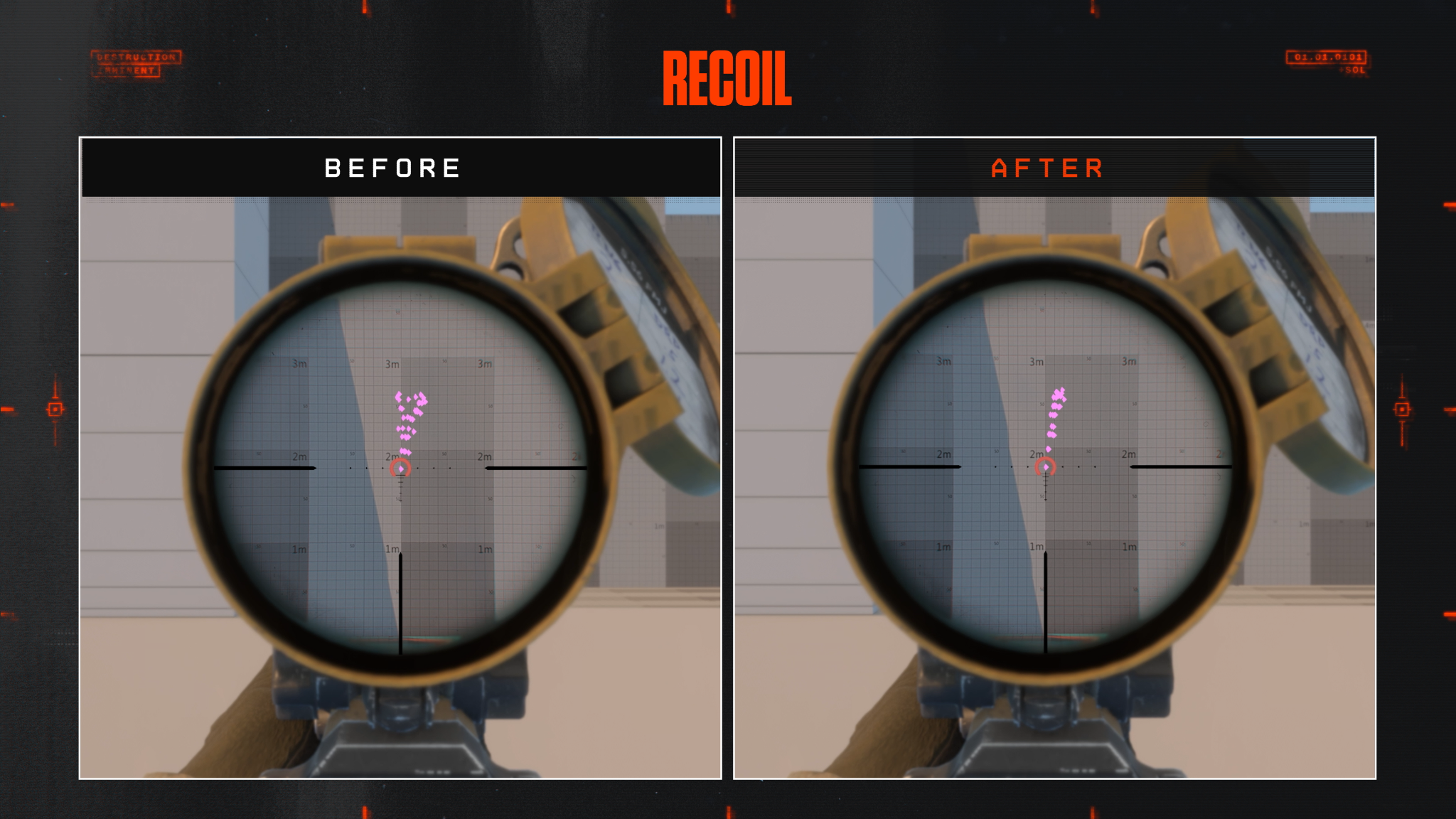
As part of our changes for combat, we’ve done a wide pass across weapons to make recoil directions more consistent and predictable, reducing the variation in direction and intensity to make it easier to master. To reward proper shooting technique, we've slightly increased bullet deviation after the first shot, making controlled bursts or tap fire even more important to stay accurate at longer distances, while keeping full auto viable for close quarters combat.
Distance and Drag
We want to make long range engagements more interesting. While initial muzzle velocities and bullet drop are tuned to keep medium range combat snappy and responsive, increased bullet drag causes projectiles to lose velocity and drop significantly past 150 meters. This preserves tactical clarity at standard combat distances while ensuring that extreme-range sniping requires immense skill, calculation, and deliberate weapon customization. We have decreased muzzle velocity for most weapons, especially SMGs, and tuned bullet drag to make anticipating the movement of targets more important.
TIME TO KILL - TTK
Our TTK benchmark in close-quarters runs between 200 and 300 milliseconds for automatic primary weapons, similar to the TTK in Battlefield 3 and 4, but with some room for outliers. To increase depth of gunplay and better reward mastery of its mechanics, we wanted to slow down average TTK without affecting the best possible TTK. We did this by adjusting damage multipliers depending on where the bullets strike their target.
Body Damage Multiplier Changes
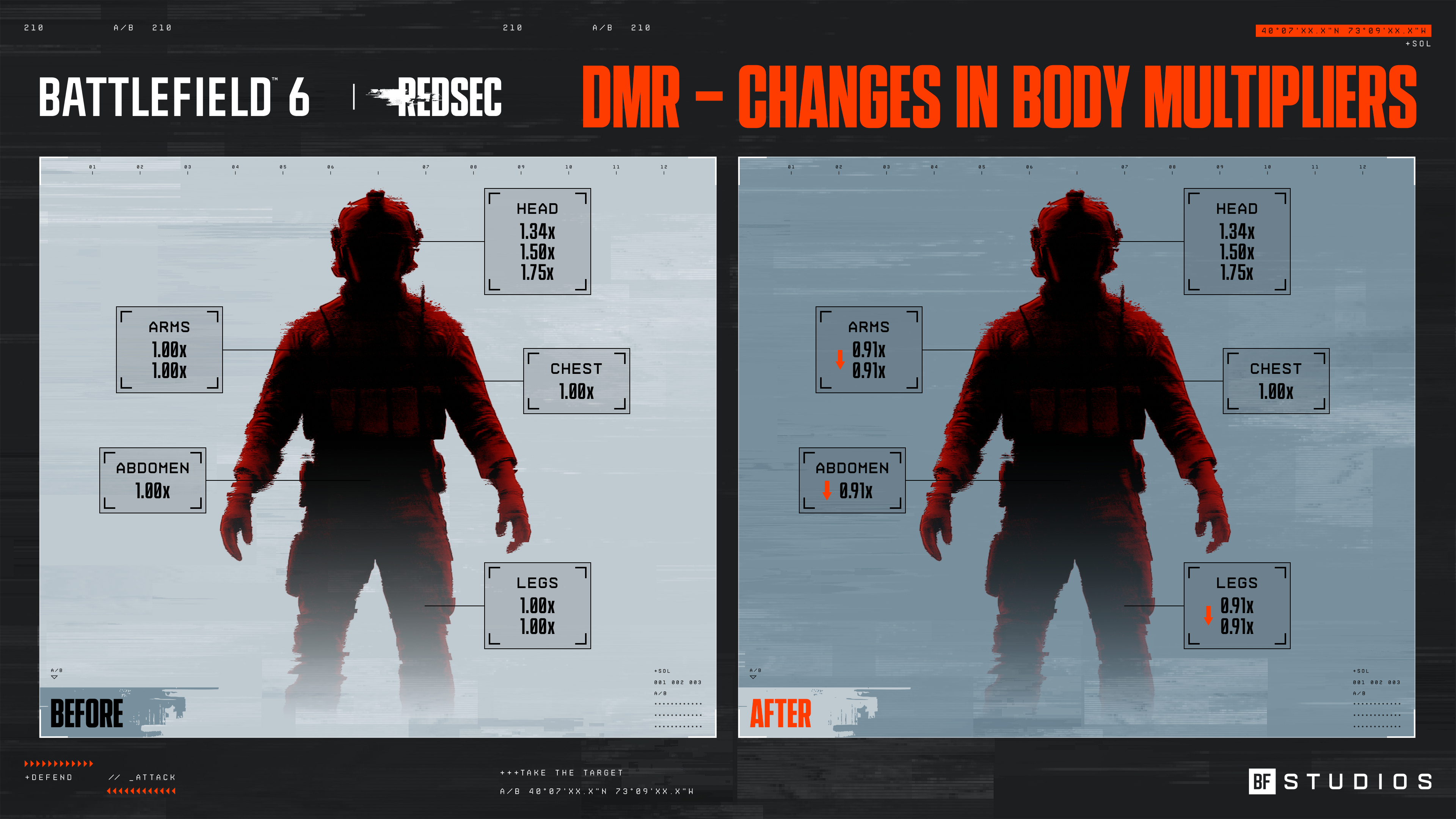
Proper shooting technique involves aiming for center mass, even though a “skillshot” to the head does the most damage. However, up until this update, weapon damage values were similar, or the exact same, across any body part but the head. This decision not only significantly impacted TTK, but also made our players feel unrewarded for accurate shooting, a root cause of shallow gameplay depth. We’ve heard community feedback loud and clear: as of this next update, damage to limbs and lower torso has been reduced for all weapon classes except for Shotguns and Sidearms. This change generally increases the amount of shots to kill by one when primarily hitting these areas, but landing headshots will compensate for the lower damage dealt to limbs and lower torso.
Read the full deep dive at https://www.ea.com/games/battlefield/battlefield-6/news/bf-combat-gunplay
Continue reading...
To that end, we’re debuting Battlefield Combat, a content series dedicated to sharing our vision for combat and how we’re evolving it over time.
Today is all about gunplay.
GUNPLAY DEPTH
As part of our changes for combat, we’ve done a wide pass across weapons to make recoil directions more consistent and predictable, reducing the variation in direction and intensity to make it easier to master. To reward proper shooting technique, we've slightly increased bullet deviation after the first shot, making controlled bursts or tap fire even more important to stay accurate at longer distances, while keeping full auto viable for close quarters combat.
Distance and Drag
We want to make long range engagements more interesting. While initial muzzle velocities and bullet drop are tuned to keep medium range combat snappy and responsive, increased bullet drag causes projectiles to lose velocity and drop significantly past 150 meters. This preserves tactical clarity at standard combat distances while ensuring that extreme-range sniping requires immense skill, calculation, and deliberate weapon customization. We have decreased muzzle velocity for most weapons, especially SMGs, and tuned bullet drag to make anticipating the movement of targets more important.
TIME TO KILL - TTK
Our TTK benchmark in close-quarters runs between 200 and 300 milliseconds for automatic primary weapons, similar to the TTK in Battlefield 3 and 4, but with some room for outliers. To increase depth of gunplay and better reward mastery of its mechanics, we wanted to slow down average TTK without affecting the best possible TTK. We did this by adjusting damage multipliers depending on where the bullets strike their target.
Body Damage Multiplier Changes
Proper shooting technique involves aiming for center mass, even though a “skillshot” to the head does the most damage. However, up until this update, weapon damage values were similar, or the exact same, across any body part but the head. This decision not only significantly impacted TTK, but also made our players feel unrewarded for accurate shooting, a root cause of shallow gameplay depth. We’ve heard community feedback loud and clear: as of this next update, damage to limbs and lower torso has been reduced for all weapon classes except for Shotguns and Sidearms. This change generally increases the amount of shots to kill by one when primarily hitting these areas, but landing headshots will compensate for the lower damage dealt to limbs and lower torso.
Read the full deep dive at https://www.ea.com/games/battlefield/battlefield-6/news/bf-combat-gunplay
Continue reading...